Case Notes
History
31 -year-old man presenting to the emergency room with acute onset of a severe right-sided headache, mastoid region and tenderness. Study is done to look for evidence of coalescent or otherwise complicated mastoiditis as a cause for these symptoms.Exam
Prior Study
Dicom
Findings
| Extracranial Structures | Correct Answer | Your Answer |
|---|---|---|
|
There is edema%2fcellulitis surrounding the pinna, periauricular soft tissues, parotid gland or masticator and parapharyngeal spaces on either side. |
No | NA |
| Right Temporal Bone | Correct Answer | Your Answer |
|---|---|---|
|
External auditory canal is abnormal. |
Yes | NA |
|
|
Yes | NA |
|
The external cortex of the mastoid process is eroded. |
No | NA |
|
There is a subperiosteal abscess along the outer margin of the mastoid portion of the temporal bone. |
No | NA |
|
|
Yes | NA |
|
|
Yes | NA |
|
There are dural reactive changes or a subperiosteal/epidural abscess along the sigmoid plate of the mastoid displacing the adjacent sigmoid sinus. |
Yes | NA |
|
The roof of the mastoid and middle ear are eroded. |
No | NA |
|
There is dural reactive change, subperiosteal, epidural or subdural abscess long the roof of the mastoid or middle ear or the surfaces of the petrous portion of the temporal bone. |
No | NA |
|
The ossicles; in particular the incus long process, the incudostapedial joint and stapes are eroded or displaced. |
Yes | NA |
|
The facial canal and nerve are abnormal. |
Yes | NA |
|
The petrous apex is abnormal. |
No | NA |
|
The inner ear, in particular the lateral semicircular canal and the cochlea are eroded or otherwise abnormal. |
No | NA |
| Left Temporal Bone | Correct Answer | Your Answer |
|---|---|---|
|
External auditory canal is abnormal. |
No | NA |
|
|
No | NA |
|
The external cortex of the mastoid process is eroded. |
No | NA |
|
There is a subperiosteal abscess along the outer margin of the mastoid portion of the temporal bone. |
No | NA |
|
|
No | NA |
|
|
No | NA |
|
There are dural reactive changes or a subperiosteal/epidural abscess along the sigmoid plate of the mastoid displacing the adjacent sigmoid sinus. |
No | NA |
|
The roof of the mastoid and middle ear are eroded. |
No | NA |
|
There is dural reactive change, subperiosteal, epidural or subdural abscess along the roof of the mastoid or middle ear or the surfaces of the petrous portion of the temporal bone. |
No | NA |
|
The ossicles; in particular the incus long process, the incudostapedial joint and stapes are eroded or displaced. |
No | NA |
|
The facial canal and nerve are abnormal. |
No | NA |
|
The petrous apex is abnormal. |
No | NA |
|
The inner ear, in particular the lateral semicircular canal and the cochlea are eroded or otherwise abnormal. |
No | NA |
| Intracranial | Correct Answer | Your Answer |
|---|---|---|
|
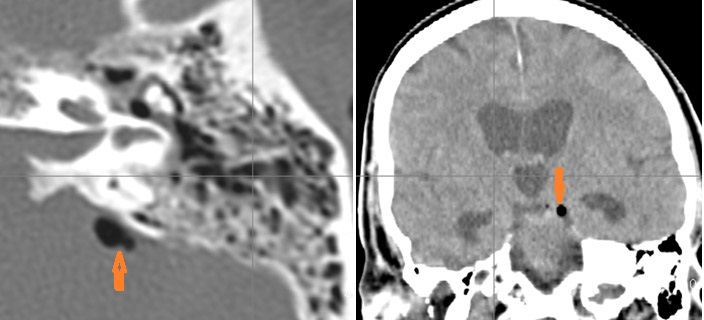
There is gas in the subarachnoid space or otherwise intracranial. |
No | NA |
|
There is evidence of thrombosis, thrombophlebitis or other occlusive or inflammatory process of the sigmoid sinus, transverse sinus, the vein of Labbe’ or jugular bulb. |
No | NA |
|
There is evidence of thrombosis, thrombophlebitis or other occlusive or inflammatory process of jugular vein. |
No | NA |
|
There is dural reactive change along the floor of the middle cranial fossa or along the inner surfaces of the petrous portion of the temporal bone. |
No | NA |
|
There is a subperiosteal, subdural or epidural abscess along the floor of the middle cranial fossa or along the inner surfaces of the petrous portion of the temporal bone. |
No | NA |
|
There is likely meningitis involving the inferior temporal lobe or adjacent cerebellum |
No | NA |
|
There is likely cerebritis involving the inferior temporal lobe or adjacent cerebellum. |
No | NA |
|
There is brain edema and/or evolving abscess present or, specifically, involving the inferior temporal lobe or adjacent cerebellum. |
No | NA |
|
There is inflammation of the distal internal carotid arteryation of the distal internal carotid artery. |
No | NA |
|
There is obstructive hydrocephalus - either intra or extra ventricular or signs of raised intracranial pressure. |
No | NA |